
Knife Steel Explained
A plain-language overview of the steels you'll see on Xinzuo and Hezhen knives, and what they mean for sharpness, edge retention, and day-to-day use.
Most Xinzuo and Hezhen knives use one of a few core steels: VG-10, 10Cr15CoMoV, or a powder steel in the M390 family. Each balances edge retention, toughness, and ease of sharpening differently, so the best steel for you depends on how you cook.
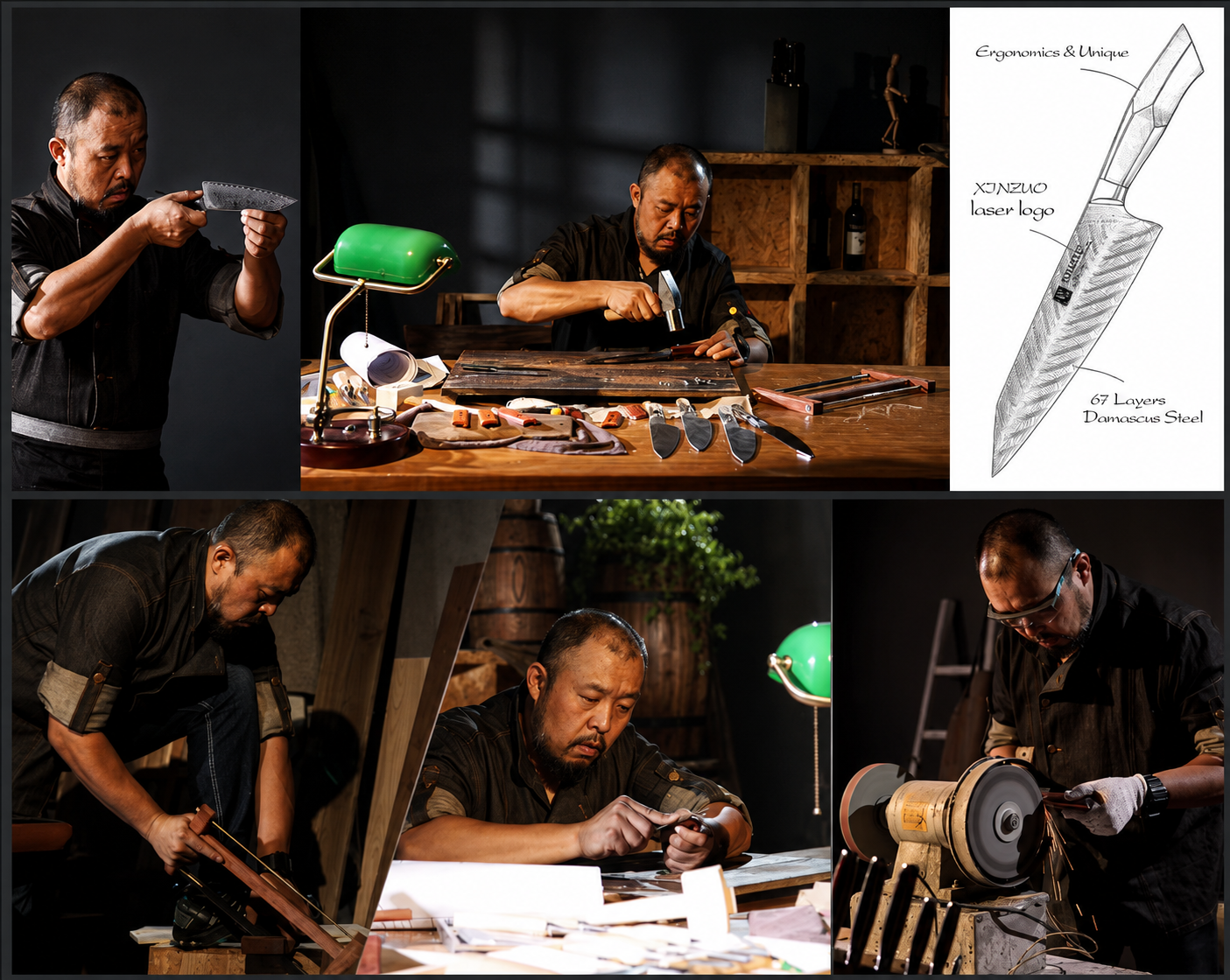
Damascus steel is the layered, patterned steel you see on many Xinzuo and Hezhen blades. It is made by folding and forge-welding multiple layers of steel together — often 67 layers or more — which creates the wavy, water-like pattern on the blade face. The layered Damascus jacket is usually wrapped around a hard core steel, and it is the core steel that does the actual cutting. The outer layers add toughness, a small amount of flexibility, and the distinctive look that makes each blade unique. Damascus is not a single steel type; it is a construction method. A well-made Damascus knife performs like its core steel, with a little extra resilience from the layered cladding.
VG-10 is a Japanese stainless steel known for taking a very fine edge. It's common in mid-tier Damascus knives. VG-10 holds its edge well, sharpens easily, and resists rust, making it a great all-around choice for home cooks who want performance without fuss.
10Cr15CoMoV is a Chinese stainless steel that behaves similarly to VG-10 at a lower price point. It typically has a slightly higher carbon content, which can mean a harder edge, but it may need a bit more care to avoid corrosion. On a budget, it's hard to beat.
Powder steels, such as M390 and its variants, are more expensive to produce. Their microscopic grain structure lets them hold an edge longer, but they take more time and skill to sharpen. These are excellent if you want maximum edge life and don't mind the maintenance.
The steel isn't the whole story. Heat treatment, blade geometry, and grind quality matter just as much. Two knives with the same steel can perform very differently depending on how well they are made.
For most home cooks, VG-10 or 10Cr15CoMoV is more than enough. If you cook every day, process a lot of protein, or simply dislike sharpening, a powder steel knife can be a worthwhile investment.